Independent supplement ratingsUS and Canada · Updated weekly

A ratings desk for a category that has spent thirty years grading its own homework.
A ratings desk for a category that has spent thirty years grading its own homework.
One is made from root only, the other from root and leaf. Their trials point at different outcomes, and their milligrams do not compare.
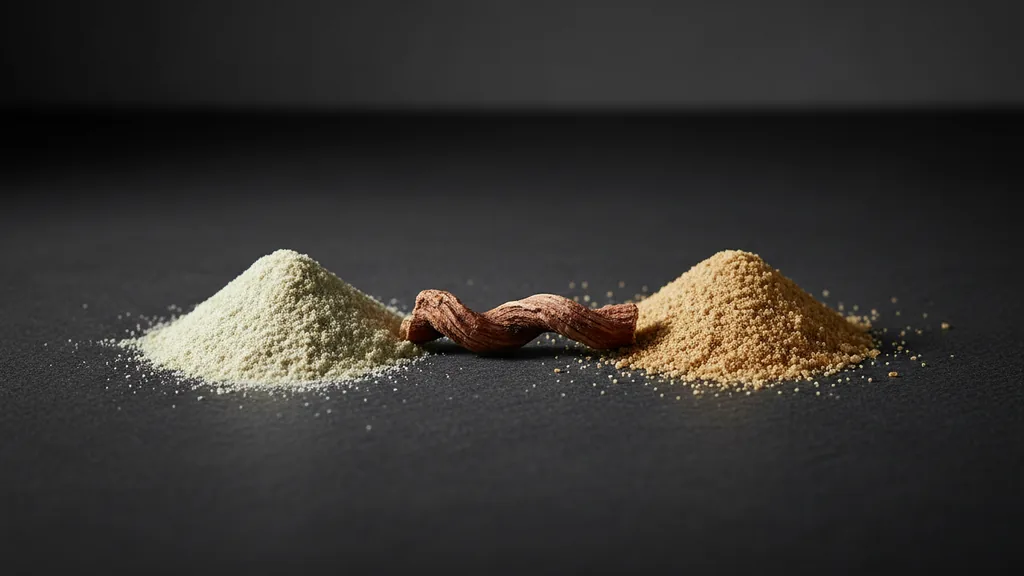
The short version: the two branded ashwagandha extracts on most labels are not interchangeable. One is made from root only, the other from root and leaf. Their published trials were run at different doses and measured different things — stress and cortisol for one, squat and bench press for the other. So "600 mg of ashwagandha" on a label tells you very little until you know which extract produced it.
Sensoril is described in the published literature as a standardized aqueous extract of the roots and leaves of Withania somnifera. (Ziegenfuss et al., 2018)
KSM-66 is the root-only extract, and the name that appears most often on the products in our ashwagandha ranking — three of the five carry it.
Leaf material is not a technicality. The leaf carries a different balance of withanolides, and extracting it changes what ends up in the capsule. Two products can both say "ashwagandha extract, 600 mg" and contain meaningfully different chemistry.
This is the part worth knowing before you buy either one.
The trials that made ashwagandha a stress supplement used high-concentration root extract.
A 2012 randomised, double-blind, placebo-controlled trial gave 64 adults with chronic stress 300 mg of a full-spectrum root extract twice a day for 60 days, measuring standard stress scales and serum cortisol. (Chandrasekhar et al., 2012)
A 2019 trial went further and varied the dose, which almost nothing in this category does. Sixty stressed adults with a Perceived Stress Scale score above 20 received 125 mg or 300 mg of root extract twice daily, or placebo, for eight weeks, with stress, anxiety, cortisol and sleep quality all measured. (Salve et al., 2019)
That gives the root-only side a dose range of roughly 250 to 600 mg a day, aimed at stress outcomes.
The named Sensoril trial is not a stress study at all. Thirty-eight recreationally active men took 500 mg a day for twelve weeks alongside a supervised four-day-a-week resistance programme. The supplement group gained more on both main lifts: squat 1RM +19.1 kg against +10.0 kg on placebo (p = 0.009), bench press +12.8 kg against +8.0 kg (p = 0.048). (Ziegenfuss et al., 2018)
Thirty-eight people in one trial is a starting point rather than a settled result, and the placebo group made real gains too. But it is a specific, measured claim, and it is a different claim from the one the root trials support.
Put the two side by side and the problem is obvious. The root trials used up to 600 mg a day of one material. The Sensoril trial used 500 mg a day of a different material, extracted differently, from different parts of the plant.
A label reading "500 mg ashwagandha extract" is either at the studied dose or well under it, depending entirely on which extract is in the bottle and which outcome you are hoping for. Milligrams are not a common currency here, and the category trades on the assumption that they are.
Which is why our Label Dose Checker compares each product against the dose used for its own extract rather than against a single number.
Two things worth noticing when you next pick up a bottle.
"Clinically studied" rarely says studied for what. A product carrying Sensoril and a stress claim is borrowing credibility from trials run on a different extract for a different outcome. The reverse happens too.
Named extracts appear at unnamed doses. Plenty of products list KSM-66 or Sensoril on the front and a fraction of the studied amount in the panel — the name does the selling and the dose does nothing. Our reviews check that gap on every product.
Neither is better in general, and anyone who tells you otherwise is selling one of them.
The five products we rate, their extracts and their doses are in the ashwagandha ranking. The broader question of whether ashwagandha works at all is in a separate piece, and the ingredient itself is broken down on our KSM-66 page.
Educational only, not medical advice. Ashwagandha interacts with thyroid medication and sedatives, and is not for use in pregnancy — talk to a clinician before starting it.