Independent supplement ratingsUS and Canada · Updated weekly

A ratings desk for a category that has spent thirty years grading its own homework.
A ratings desk for a category that has spent thirty years grading its own homework.
Pooled across 23 trials it does raise testosterone in men, by about 57 ng/dL. The trial that measured how men felt found no difference at all.
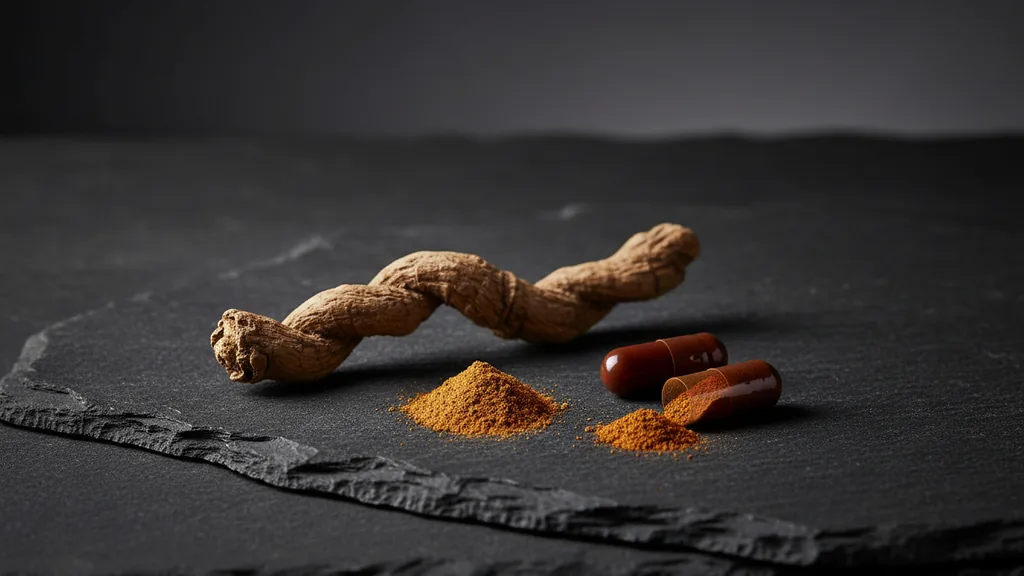
The short version: this one is unusual, because the claim is true and still misleading. Pooled across 23 randomised trials, ashwagandha does raise testosterone in men — by about 57 ng/dL. It does not raise it in women. And in the best-designed trial that measured both, the hormone moved while fatigue, vigour and sexual well-being did not.
A 2026 systematic review and meta-analysis gathered every randomised placebo-controlled trial reporting hormone changes with oral ashwagandha — 23 trials, 1,706 participants, with the protocol registered in advance and risk of bias assessed with the Cochrane tool. (Fornalik et al., 2026)
On hormones, it reported:
The reviewers flag heterogeneity between trials and limited data on some endpoints. Their own summary asks for further standardised trials, which is the right note to end on.
A typical laboratory reference range for total testosterone in adult men runs from roughly 300 to 1,000 ng/dL. Against that, 57 is a real shift and a small one — somewhere between six and nineteen per cent, depending where you started.
What it is not is a treatment. A man at 250 ng/dL, in the range where a doctor starts paying attention, is not moved into comfortable territory by 57 points. A man already at 600 has gained a number he will never notice.
That is the gap the marketing lives in. The claim "clinically shown to increase testosterone" is accurate, and it does not mean what a reader takes it to mean.
This is the part that settles it. A 16-week randomised, double-blind, placebo-controlled crossover study in overweight men aged 40 to 70 with mild fatigue gave a standardized extract for eight weeks and measured hormones and outcomes.
Testosterone rose 14.7% more than placebo (p = .010) and DHEA-S rose 18% more (p = .005). And on fatigue, vigour, and sexual and psychological well-being there were no statistically significant differences between the groups. (Lopresti, Drummond & Smith, 2019)
Both groups improved on those measures. The supplement group did not improve more. The hormone was the thing that moved.
The most likely explanation is that ashwagandha is not a testosterone supplement at all — it is a stress supplement whose effect on testosterone is downstream.
Cortisol and testosterone sit on the same axis, and sustained cortisol suppresses testosterone. The meta-analysis found ashwagandha lowers cortisol with a substantially larger effect size than anything it does to testosterone directly. A narrative review of the two best-documented herbal extracts reaches the same conclusion, describing the likely mechanism as ashwagandha blunting cortisol's effect on the hypothalamic-pituitary-gonadal axis rather than stimulating production. (Skrzypiec-Spring et al., 2025)
Which fits the trial data neatly. Take the pressure off a stressed system and testosterone drifts up a little. Take it off a system that was not under pressure and very little happens.
The five products we rate, with their extracts and doses, are in the ashwagandha ranking.
Educational only, not medical advice. Ashwagandha interacts with thyroid medication and sedatives and is not for use in pregnancy. Low testosterone is diagnosed with a blood test, not from a shelf.